You know that feeling when you walk into someone’s apartment and something just feels off, but you can’t quite put your finger on it? The furniture is nice. The colors are fine. But the room feels cramped, or the layout forces you to walk around things in awkward ways, or there’s a beautiful dining table shoved into a corner where nobody actually wants to sit.
That’s a space planning problem. And it’s more common than you’d think, especially in Kosovo’s apartment market.
What Space Planning Actually Means
Space planning is the behind-the-scenes discipline that makes the difference between a home that looks good in photos and a home that actually feels good to live in. It’s about how rooms connect, how you move through the space, where the light falls, and whether every square meter is earning its keep.
Before we pick a single piece of furniture or choose a paint color for any project, we start with the spatial plan. Always. Because a beautiful sofa in the wrong position is still a beautiful sofa in the wrong position.
It’s Not the Same as Decorating
People mix these up constantly, and it’s an important distinction. Decorating is the visual stuff: colors, textures, accessories, styling. Space planning is the structural stuff: where walls go, how furniture is arranged, where you walk, and how different areas of the home relate to each other.
Think of it this way. Space planning is the skeleton. Decorating is the outfit. And no amount of great clothing fixes bad posture.
We’ve seen gorgeous apartments where someone clearly spent a fortune on furniture and finishes but didn’t think about the layout. The result always feels off. On the flip side, a well-planned space feels comfortable and intuitive even when it’s almost empty. That’s the power of getting the bones right.
Why Traffic Flow Matters More Than You Think
Circulation is the designer’s term for how people move through a space. And when it works, you don’t notice it at all. You just glide from the entrance to the living room, from the kitchen to the table, from the bedroom to the bathroom, without thinking about it.
When it doesn’t work? You feel it constantly. Bumping into the corner of the dining table every morning. Squeezing past a sofa to reach the balcony door. Walking through someone’s workspace to get to the kitchen.
In the open-plan apartments that are everywhere in Prishtinë’s newer buildings, circulation planning becomes critical. There are no walls to guide you, so furniture has to do double duty: defining areas while keeping paths clear. It’s a balance that takes real thought to get right.
Zones: Giving Every Area a Job
Every home has functional zones, even if you haven’t consciously defined them. There’s where you cook. Where you eat. Where you relax. Where you sleep. Where you work (especially now). Where you store things.
Good space planning makes these zones clear without using walls. A rug under the living area. A change in lighting over the dining table. A bookshelf that subtly separates the office corner from the rest of the room. These moves seem small, but they’re the difference between a space that feels organized and one that feels like everything’s bleeding together.
In smaller Kosovo apartments, the challenge is creating these distinct zones without making the space feel chopped up. We do this all the time, and the techniques that work best are usually the simplest: furniture positioning, lighting changes, and material transitions. No walls required.
Natural Light: Your Most Valuable Asset
Nothing affects how a space feels more than light. It changes your mood, your energy levels, how large a room seems, even your property value. And space planning determines whether you’re making the most of whatever natural light you have.
The basics: put your main living areas near the biggest windows. Don’t block light with tall furniture. Use lighter colors and reflective surfaces to push light deeper into the room. And when you’re choosing how to divide or arrange spaces, always ask yourself: am I cutting off a light source?
In a lot of Prishtinë apartments, you’re working with a limited number of windows. That makes every decision about light more important. We’ve had projects where simply moving the living area from one end of the apartment to the other (closer to the larger window) completely transformed how the space felt. Same furniture, same finishes. Just smarter planning.
Furniture Placement (and Why Your Instincts Might Be Wrong)
Here’s one of the most counterintuitive things in interior design: pushing all your furniture against the walls usually makes a room feel smaller, not bigger. People do it because they think they’re “opening up” the center of the room. But what actually happens is you create a ring of furniture around an empty void in the middle that nobody uses.
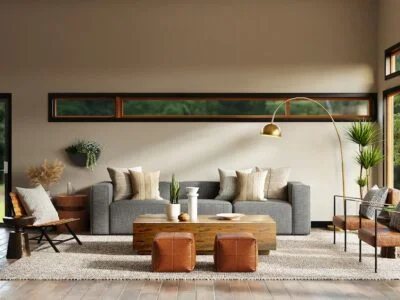
Floating furniture away from walls creates depth. A sofa in the middle of the room, with a console table behind it, can actually make the space feel larger and more purposeful. Conversation groupings should be within about 2.5 to 3 meters. Every seat should have access to a surface for a drink or a phone.
For smaller apartments, multifunctional furniture becomes essential. Dining tables that extend. Sofas with storage. Desks that fold into walls. But here’s the key: space planning tells you which multifunctional solutions you actually need before you start shopping. Otherwise you end up with a bunch of clever furniture that doesn’t quite work together.
Storage: The Problem Nobody Plans For
We’ve all been to that apartment. Beautiful design, nowhere to put anything. Coats piled on chairs. Shoes by the door. A bookshelf overflowing onto the floor.
Storage is fundamentally a space planning problem. The best solutions are the ones built into the architecture itself: floor-to-ceiling wardrobes, kitchen cabinets that go all the way up, built-in shelving in dead corners, drawers under beds. And vertical space is almost always underused, especially in Kosovo apartments where ceiling heights are often quite generous.
We actually do a storage audit as part of our planning process. How many shoes? How many coats? How much kitchen equipment? Books? It sounds mundane, but it’s the difference between a home that stays tidy and one where stuff slowly takes over.
The Mistakes We Keep Seeing
After hundreds of residential projects across Kosovo, some patterns are painfully familiar. Oversized sofas that leave no room to walk around them. Kitchens where the fridge, sink, and stove are arranged in a way that makes cooking feel like an obstacle course. Hallways treated as dead space when they could be lined with shallow storage. Balconies completely ignored instead of treated as extensions of the living space.
Every one of these problems traces back to the same root cause: not enough thought went into planning before the furniture arrived or the construction started.
The Tools That Make It Possible
Modern space planning uses scaled floor plans and 3D modeling to test layouts before committing to anything. You can try five different furniture arrangements in a day. You can see whether that kitchen island leaves enough clearance for the dishwasher door. You can experience the flow of the entire apartment in a virtual walkthrough.
We produce these for every project. They take the guesswork out of planning and let clients make decisions with real confidence instead of crossed fingers.
When It’s Time to Call a Professional
Rearranging your living room furniture on a Saturday afternoon? You probably don’t need us for that. But if you’re renovating, building new, or making any significant layout changes, professional space planning prevents mistakes that are expensive and frustrating to fix after the fact.
If your current space frustrates you and you can’t figure out why, there’s a good chance the answer is in the plan, not the decor. Come talk to us about it. Sometimes all it takes is a fresh pair of eyes and a proper floor plan to unlock a space’s real potential.