
“Do I need an architect or an interior designer?” is the most common question on the first call we take from any prospective client. The English-language web is unhelpful here — most articles are written for the US market, where definitions and licensing rules are different from Europe; many use “interior designer” and “interior decorator” interchangeably; and almost none address what really happens when you need both professions on the same project. This guide fixes that. It is written from the perspective of a multidisciplinary European studio that runs both kinds of work daily, and it is structured to give you a clear answer for your specific project type before the end of the article.
What an architect actually does
An architect designs buildings as physical objects. The work covers the structure, the building envelope (walls, roof, facade), the relationship between the building and the site, the building’s compliance with planning law and building code, and the documentation required to obtain construction permits. On larger projects, architects also coordinate engineering disciplines — structural, mechanical, electrical, fire safety — into a coherent technical design.
In most European countries, “Architekt”, “architecte”, “architetto” or equivalent is a legally protected title, requiring registration with a professional chamber after a regulated education and a period of supervised practice. Anyone signing structural drawings or submitting building permit applications must hold the legal title. This protection exists because architects’ decisions affect public safety: a wrongly sized beam, a wrongly designed escape route, a wrongly detailed fire wall can kill people.
What an interior designer actually does
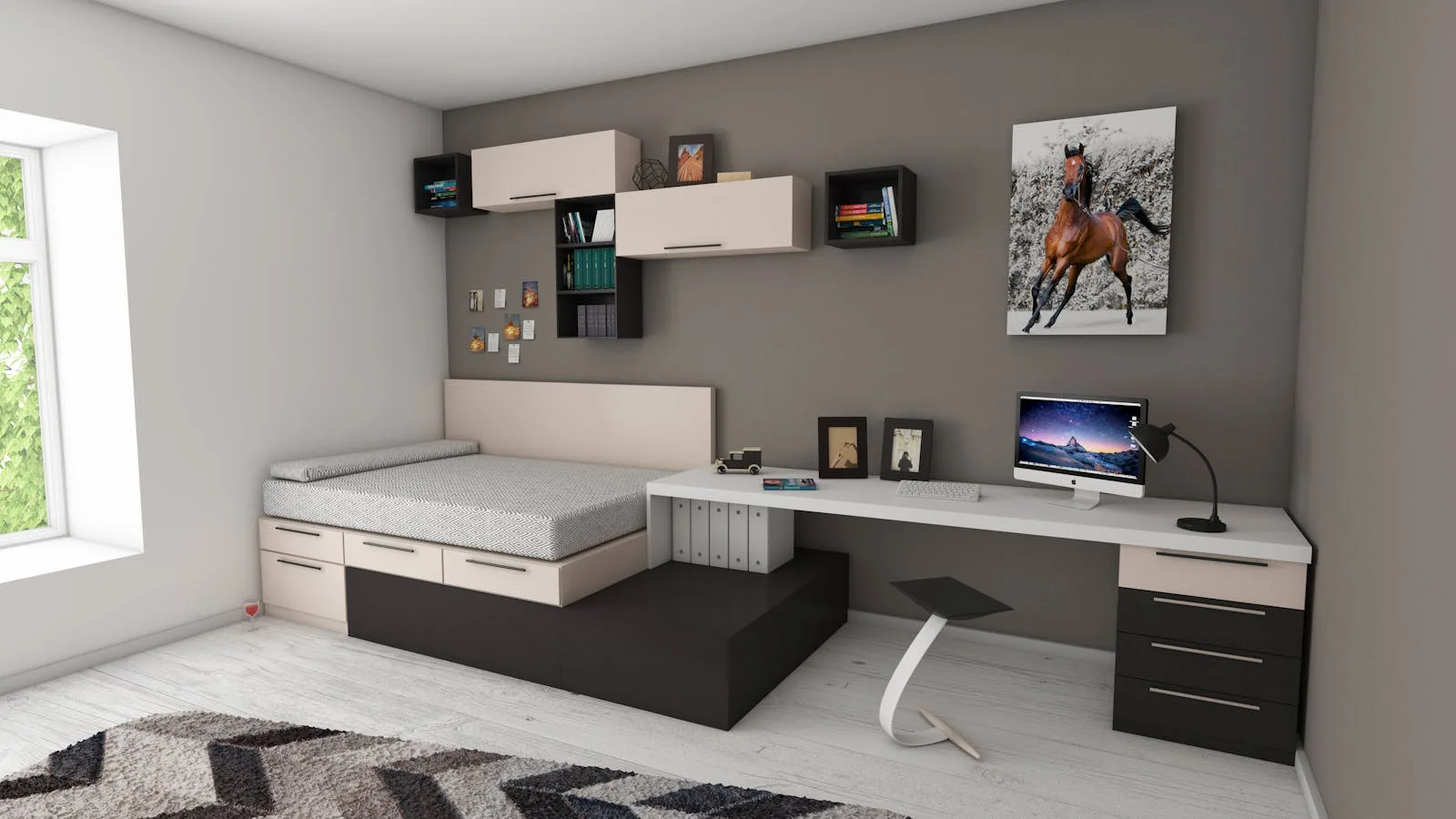
An interior designer plans how the inside of a space is used and experienced. The work starts with how people will move through and occupy the space — flow, sightlines, zones, daylight, acoustics — and then resolves every interior decision required to deliver that intent: layout, partition design (non-structural), lighting design, material selection, joinery, fixtures, furniture, soft furnishing, and finishes.
A serious interior designer’s drawing set looks much like an architect’s: scaled plans, sections, elevations, electrical and lighting layouts, joinery details, finishes schedules. The difference is that the architect’s drawings define the building; the interior designer’s drawings define how that building is configured for use. The two scopes overlap — a non-structural wall in a partition strategy can be drawn by either — but they are answering different questions.
The European title situation: why this matters
The “interior designer vs architect” comparison is complicated in Europe because title protection varies by country. International clients are sometimes confused by this — a “studio of interior architects” in Berlin is not the same legal entity as a “studio of interior architects” in London. Here is the practical situation.
- Germany: “Innenarchitekt” is a protected title; registered members of an Architektenkammer can submit certain types of permit applications. Information on the profession is published by the bdia (Bund Deutscher Innenarchitekten)
- Austria: similar to Germany; protected by the relevant Kammer
- Switzerland: title regulated through professional associations including VSI; cantonal differences apply
- United Kingdom: “interior designer” and “interior architect” are not protected; “Architect” is protected by the Architects Registration Board
- France: “architecte d’intérieur” is regulated through professional bodies (CFAI), though less strictly than “architecte”
- Italy, Spain: “interior designer” not legally protected; some specialised university programmes exist
- Kosovo, Albania, Serbia, North Macedonia: increasing alignment with EU professional standards; serious studios staff registered architects alongside design teams
Practically, when you hire a serious European studio, you should ask two questions: who on the team is a registered architect (capable of signing structural and permit drawings), and who leads the interior design (the joinery, lighting, materials, furniture). On well-run multidisciplinary projects, these are different people working together on the same brief.
The decision framework
Three questions decide which professional you need. Walk through them in order before contacting any studio.
- Does the project involve structural changes? Removing or adding load-bearing walls, changing roofs, modifying foundations, adding extensions. If yes, you need an architect or a structural engineer signing off — no exceptions
- Does the project require a building permit? Almost any change to the building envelope, change of use, or major structural change does. If yes, you need an architect (or in some countries a registered “Innenarchitekt”) to file the application
- Is the focus on how the inside will be used and finished? Layout planning, lighting, materials, joinery, furniture, soft furnishing. If yes, you need an interior designer leading — even if you also need an architect for the structural work
The combinations are: only an architect (rare for finished projects — most clients want the inside resolved too); only an interior designer (the majority of refurbishment and fit-out projects); both, working together (any project that combines structural change with serious interior design). The third option is where a multidisciplinary studio outperforms two separate firms.

Eight project scenarios — and the right answer for each
Generic decision tables are useful only up to a point. Here are eight specific project scenarios we see weekly, with the right professional choice for each.
Scenario 1: Refurbishing an apartment, no walls moved
You need: an interior designer. Replanning the kitchen, redoing two bathrooms, fitting wardrobes, redesigning lighting, replacing floors, and redecorating the living areas all sit comfortably inside an interior designer’s scope. No architect needed.
Scenario 2: Refurbishing an apartment with one or two non-structural walls moved
You need: an interior designer, with structural engineer sign-off. Most “non-structural” walls in apartment buildings still require a structural engineer to confirm they are non-load-bearing before they can be removed. A serious interior designer will commission and coordinate this engineer as part of their service. No architect needed unless permit submission requires one.
Scenario 3: Building a new villa from scratch
You need: both, ideally inside one studio. An architect designs the building and obtains permits. An interior designer plans the inside in parallel — it is far more efficient to design joinery, lighting, and materials alongside the structure than to wait until the shell is complete. A multidisciplinary studio coordinates both roles inside one team; otherwise expect 12 to 20 weeks of additional coordination time.
Scenario 4: Office fit-out in an existing building
You need: an interior designer. Modern office fit-outs are interior projects. Layout, acoustics, lighting, furniture, technology integration, biophilic elements — all interior design scope. An architect is needed only if the landlord requires permit-level changes to the building envelope (rare in commercial fit-outs) or if you are converting a building to office use for the first time.
Scenario 5: Restaurant in an existing retail or hospitality unit
You need: an interior designer with hospitality experience. Restaurant design is interior design at its most demanding — kitchen integration, ventilation, fire compliance, acoustics, guest flow, lighting layers. An architect may be required for ventilation routing through the building envelope and for change-of-use permits, but the interior designer leads the project.
Scenario 6: Boutique hotel conversion (warehouse, mansion, or office to hotel)
You need: both, in equal measure. Hotel conversions involve change of use, fire compliance, accessibility, structural reinforcement, mechanical services overhaul — all architect scope. They also involve every interior decision a hotel makes, room by room — interior designer scope. Multidisciplinary studios are particularly strong here; otherwise, hire one architectural and one interior firm and budget heavily for coordination meetings.
Scenario 7: Adding an extension to a house
You need: an architect first, interior designer second. The extension itself is architectural — structure, envelope, planning permission. Once the design is established, an interior designer plans how the new space connects to the existing house and resolves the inside finish. Engaging the interior designer early — at concept stage rather than after construction — saves significant rework later.
Scenario 8: Loft conversion in an existing apartment
You need: both, with architect leading initially. Loft conversions involve changes to the roof structure, sometimes external changes to the building envelope, and almost always require permits. The architect handles the shell; the interior designer plans the inside use, lighting, and finish. On smaller lofts (under 60 m²), a multidisciplinary studio will often deliver this in a single contract.
Cost comparison: architect vs interior designer fees
Direct fee comparison is misleading because the two professionals charge for different work. The numbers below are 2026 European mid-market rates for full service in their respective scopes.
- Architect, full service on residential project: 9 to 18 percent of construction cost
- Architect, partial service (concept and permit only): 4 to 8 percent of construction cost
- Interior designer, full service on fit-out: 8 to 15 percent of construction cost
- Interior designer, concept-only: 3 to 6 percent of construction cost
- Multidisciplinary studio, combined scope: 12 to 20 percent of construction cost — typically lower than the sum of two separate firms doing the same work
For a 250,000 euro construction budget, this means roughly 22,500 to 45,000 euros for full architectural service, 20,000 to 37,500 euros for full interior service, or 30,000 to 50,000 euros for combined service inside a multidisciplinary studio. Hiring two separate firms for the same combined scope typically lands between 38,000 and 60,000 euros once coordination overhead is added.
How multidisciplinary studios combine both roles
A multidisciplinary studio is not simply two firms under one roof. It is a single team where architect and interior designer work to the same brief, the same model, the same client relationship. In practice this means:
- One contract, one client point of contact, one fee structure
- One coordinated drawing set — the architect’s plans are the same plans on which interior layouts are designed
- One 3D model that everyone works in — no version control battles between two firms
- One on-site supervision team during construction — no finger-pointing between separate consultants
- One integrated programme — the architect’s permit phase aligns with the interior designer’s specification phase
The result is shorter timelines, fewer change orders, and lower coordination cost. For projects below 800 m² that combine structural and interior scope, multidisciplinary studios consistently outperform the two-firm model. For very large projects (above 5,000 m² or with complex engineering), it remains common to retain a specialist architecture firm and a specialist interior firm separately, with formal coordination protocols between them.
When to hire two separate firms
The two-firm model still makes sense in three situations. First, on very large projects (large hotels, mixed-use developments, public buildings) where each discipline benefits from specialist depth that no multidisciplinary studio can match. Second, when the building requires a heritage architect with specific listed-building experience that an interior-led studio cannot provide. Third, when the client already has an existing architectural relationship and is adding interior scope mid-project — bringing in a separate interior firm is sometimes more practical than restructuring the existing contract.
If you do hire two separate firms, insist on three contractual safeguards: a shared 3D model with clear ownership, named coordination meetings on a fixed cadence, and a single point of accountability for site issues. The most common failure mode of split-firm projects is exactly this: when something goes wrong on site, neither firm wants to own it.
What actually decides the right answer
Cut through the language and the question is simple. If your project changes the building, you need an architect. If your project shapes how people use the inside, you need an interior designer. Most real-world projects sit somewhere on the spectrum between the two, which is why multidisciplinary studios have become the default choice for European clients who want a single contract, a single team, and a single 3D model that resolves the project end to end.
Doyenne is a multidisciplinary studio based in Prishtinë, Kosovo, combining interior design, architecture, 3D visualisation, and on-site supervision under one roof. Over 230 completed projects across residential, hospitality, retail, and office work in Kosovo, Albania, and the German-speaking region give us the scope to lead either side of the discipline — or both, when a project needs them together. If you are unsure whether your project needs an architect, an interior designer, or both, book a no-obligation initial consultation. We will give you a clear answer in the first conversation.
Want to see comparable work? Explore our portfolio or read about our full service offering.