Most leadership teams still treat office interior design as an aesthetic decision. They ask whether the kitchen looks good, whether the meeting rooms photograph well for LinkedIn, whether the reception communicates the brand. These are real questions, but they miss the much larger one: a well-designed office measurably improves productivity, accelerates hiring, and reduces attrition — and in 2026, those three outcomes carry euro values that completely overshadow the design fee. This guide sets out the actual data, the five zones every modern office needs, why acoustics is the single most important driver, and how to build an ROI case for your office investment with a worked 50-person payback example.
The productivity data: what the research actually shows
Three large bodies of research dominate the workplace productivity literature: the Leesman Index, Steelcase’s Workplace Survey, and the various Gensler Workplace Surveys. Each samples differently, but they converge on the same numbers.
- Productivity uplift: well-designed offices report 10 to 20 percent higher self-reported productivity than poorly designed ones; structured task-based studies typically find 6 to 15 percent measurable uplift on cognitive tasks
- Engagement: employees in offices ranked in the top quartile of design quality report engagement scores 25 to 35 percent above those in the bottom quartile
- Wellbeing: well-designed offices reduce reported stress by 15 to 25 percent and absenteeism by 8 to 12 percent in longitudinal studies
- Retention: companies investing in workplace quality typically report voluntary attrition 15 to 25 percent below comparable companies in their sector
- Recruiting: time-to-hire reduces by 20 to 30 percent in companies whose office quality is consistently rated high in candidate exit surveys
The Leesman Index, which has surveyed more than a million European office workers since 2010, gives the most useful single benchmark. Conventional offices score below 60 on Leesman’s productivity scale; well-designed offices score above 80. The 20-point difference correlates strongly with self-reported productivity — and with attrition, engagement, and absenteeism in follow-up data.
The recruiting and retention argument
For leadership teams, the productivity argument is interesting but hard to put on a balance sheet. The recruiting and retention argument is direct cash. In 2026 European labour markets, the cost of replacing a mid-level knowledge worker — recruitment fees, lost productivity during ramp-up, training, manager time — typically runs 50 to 200 percent of that worker’s annual salary. For senior roles, replacement cost can exceed 400 percent of salary.
If a workplace investment of 800,000 euros reduces attrition by even three or four people per year in a 50-person office, the investment has paid for itself inside 18 months on retention alone. That is the basic ROI logic, before any productivity uplift is counted.
The hiring story is similarly direct. In the candidate-led labour markets of Germany, Switzerland, the Netherlands, and the Nordic countries, office quality has become a meaningful differentiator. Recent workplace surveys consistently rank office environment in the top five decision factors for under-35 candidates, particularly in technology, professional services, and creative industries. Companies that show their office credibly during the interview process — proper photos, video tour, in-person visit at offer stage — close offers significantly faster than those that hide a tired environment.
Hybrid work in 2026: what changed and what didn’t
By 2026, hybrid work has settled into a stable pattern across most European knowledge-work organisations: two to three office days per week, with the office used disproportionately for collaboration, training, and social interaction, and home used for focus work. The implications for office design are significant.
- Smaller footprints, richer zones: most companies have reduced total office area by 20 to 35 percent versus 2019, but allocated more square metres per person to non-desk space
- Collaboration as the centre of gravity: the office’s primary role is no longer “place to do focused work” but “place to do work that requires being together”
- Hot-desking with caveats: pure hot-desking has lost popularity; “neighbourhood-based” assigned zones with shared desks are now dominant
- Booking systems as design constraints: every meaningful collaboration space needs digital booking; design must accommodate the technology gracefully
- Social spaces as productivity tools: the kitchen, café, and lounge layer is no longer a perk — it is the connective tissue of hybrid teams
The single most important design question in 2026 is no longer “how many desks do we need” but “what gives our people a reason to come in”. A 2026 office that simply offers desks loses the recruiting and retention battle to companies that have built environments worth the commute.
The five zones every modern office needs
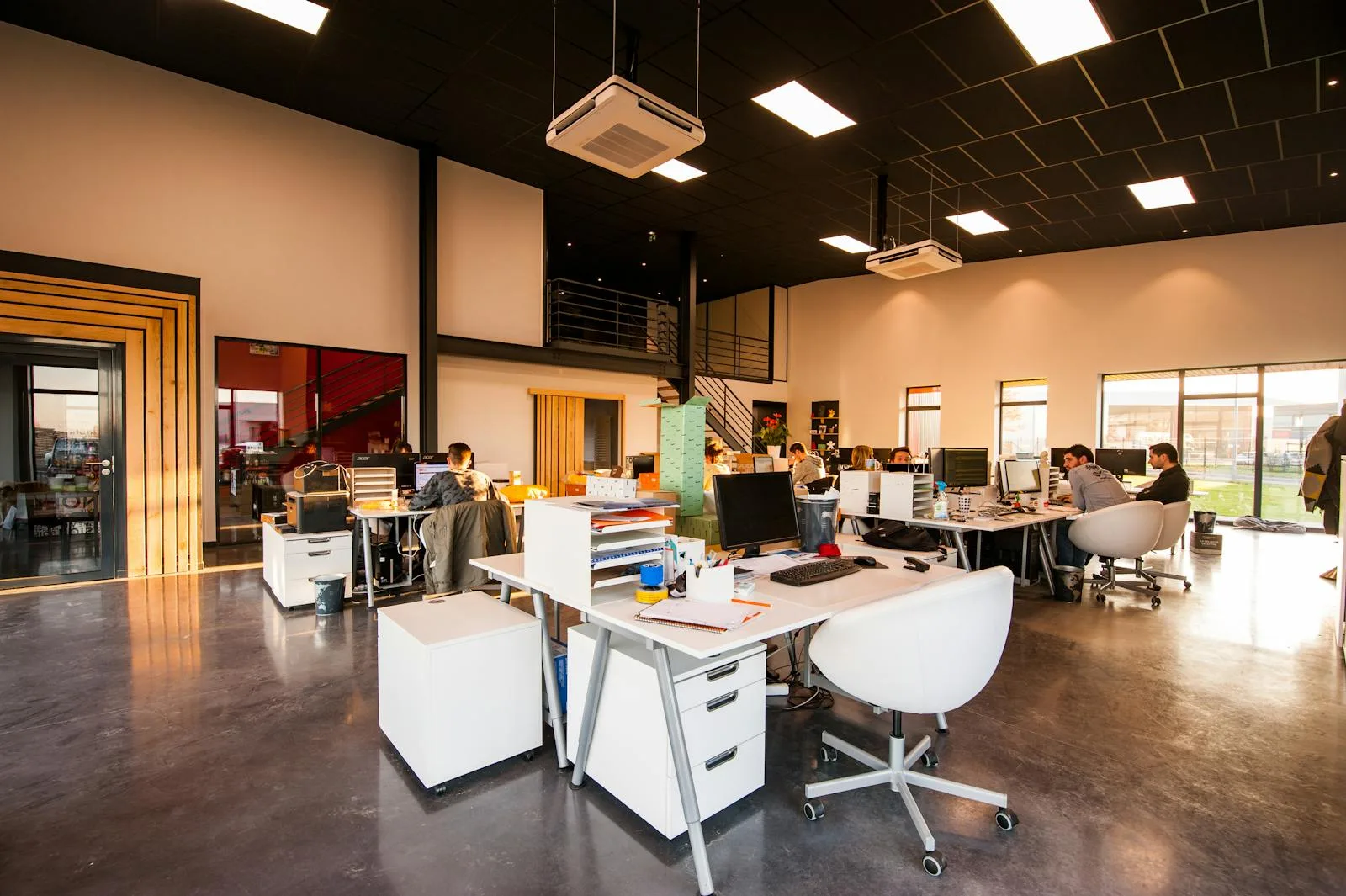
Twenty years of workplace research has converged on a five-zone model. The exact proportions vary by company culture, but cutting any one zone produces measurable downstream cost.
1. Focus zones
Quiet, individual, deep-work spaces. Acoustically separated from collaboration zones. Examples: phone booths, focus rooms for two to four people, library-style quiet floors. In hybrid offices, focus zones are smaller in absolute terms but more intensively used — booking demand for focus rooms typically outpaces collaboration rooms by 30 to 50 percent in 2026 surveys. Cutting focus zones reduces productivity directly.
2. Collaboration zones
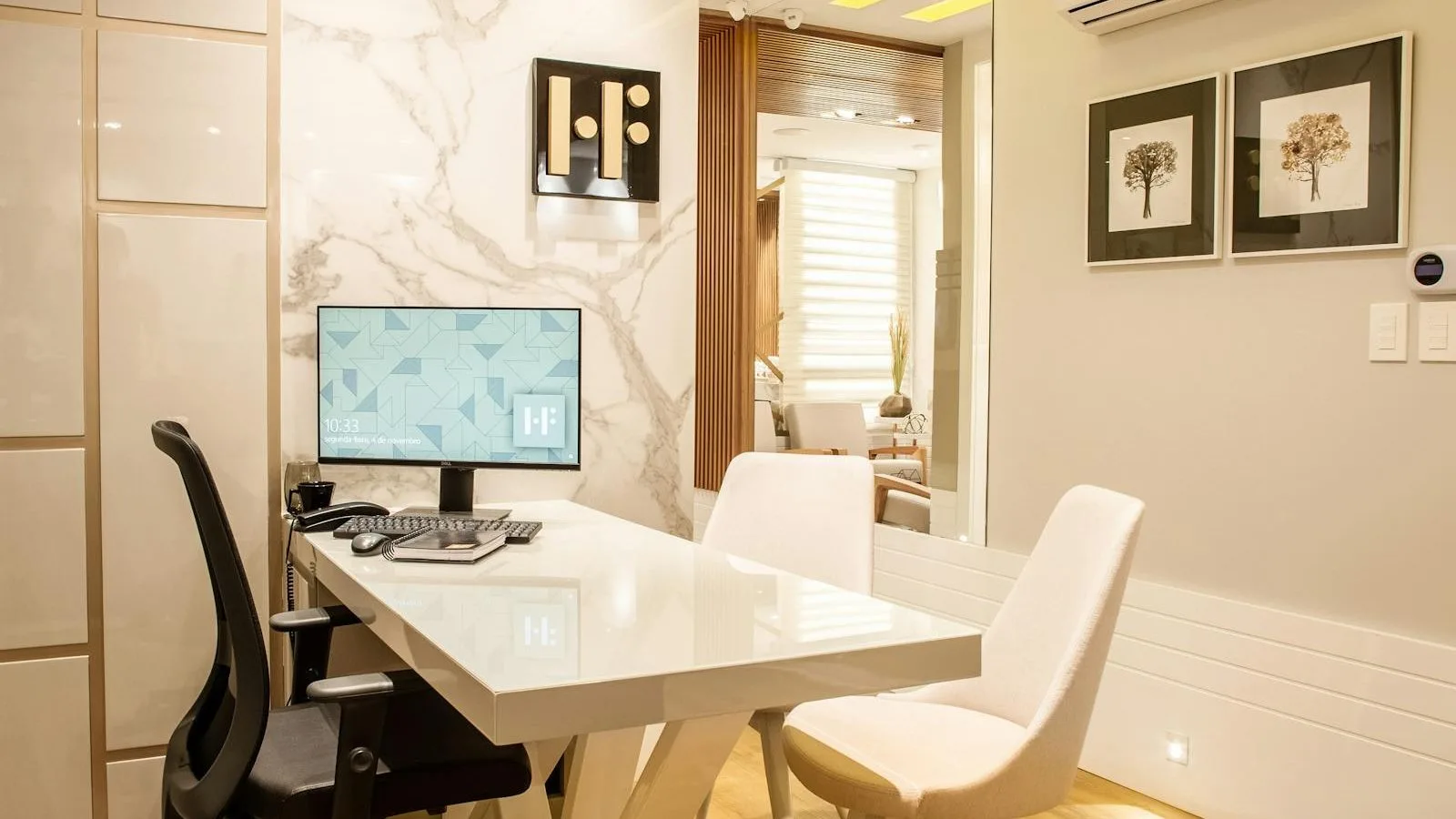
Project rooms, whiteboard walls, video-equipped meeting rooms, open team areas. The technological standard has risen sharply since 2020 — every meaningful collaboration room needs a properly designed video setup that includes hybrid colleagues without the awkwardness of tinny audio and in-room dominance. Cutting collaboration zones undermines the core hybrid use case for the office.
3. Social zones
Kitchen, café, lounge, informal meeting layer. The role here is connective tissue — the unscheduled conversations that build trust between people who otherwise see each other only in scheduled video calls. Companies that downsize the social layer to “just a kitchen” lose 25 to 40 percent of the relationship-building benefit of being in the office at all. Cutting social zones reduces retention.
4. Restorative zones
Quiet rooms, wellness rooms, prayer rooms, places to recover from intensive work or difficult conversations. Often the smallest zone by area but disproportionately important for inclusion and wellbeing. The 2026 baseline expectation in serious European offices is at least one wellness room per 80 to 120 employees. Cutting restorative zones reduces resilience and signals that wellbeing is a slogan rather than a commitment.
5. Learning zones
Training rooms, mentoring spaces, reconfigurable areas for workshops. Often combined with collaboration space using flexible furniture. Learning zones are the easiest to under-invest in because their use is intermittent — but they are the difference between an office that supports growth and one that only supports execution. Cutting learning zones reduces talent development and hampers progression conversations.

Acoustics: the single most important driver
If you can only invest in one design lever, invest in acoustics. Across every workplace post-occupancy survey in the European market, acoustic comfort ranks as either the most-cited reason for satisfaction or the most-cited reason for dissatisfaction — ahead of ergonomics, daylight, temperature, or aesthetics. The reason is simple: most knowledge work involves sustained concentration, and most office environments are loud enough to disrupt it.
European acoustic standards exist for good reason. DIN 18041 in Germany sets quantitative targets for reverberation time and speech intelligibility in different room types. Equivalent standards exist across most EU countries. A serious workplace designer will design to these standards as a minimum, often exceeding them in focus areas.
- Sound-absorbing ceilings: high-performance acoustic panels with low reverberation
- Wall and floor treatments: textile finishes, acoustic panels, soft flooring in transition zones
- Spatial separation: focus zones acoustically isolated from collaboration zones, ideally on different floors or with full-height partitions
- Phone booths: at least one booth per 8 to 12 employees in hybrid offices
- Sound masking: in larger open areas, low-level pink noise to mask conversational distraction
- Ventilation noise control: HVAC systems specified for low background noise levels
The cost of doing acoustics well in a new fit-out is 80 to 150 euros per square metre, or roughly 5 to 10 percent of total fit-out cost. The cost of doing acoustics badly is paid every working hour by every employee, in concentration loss, stress, and dissatisfaction.
Biophilic design: what the research really says
Biophilic design — the integration of natural elements into built environments — has moved from fringe topic to mainstream expectation across European workplace projects. The research base is substantial and credible, though the marketing claims around biophilic design are often more enthusiastic than the data warrants.
- Daylight: the most evidenced biophilic intervention; access to daylight correlates with better sleep, mood, and self-reported productivity. Position desks within 6 metres of windows where possible
- Views to nature: even a partial view of greenery measurably reduces stress recovery time after demanding tasks
- Living planting: improves air quality marginally and wellbeing measurably; requires real maintenance budgets — fake plants do not deliver the same benefit
- Natural materials: wood, stone, wool, linen — appear to support relaxation responses; the evidence is weaker than for daylight but consistent
- Water features: a real but modest effect on perceived calm; high maintenance cost in office settings
- Natural ventilation: where building services and acoustics permit, mixed-mode ventilation systems are increasingly preferred to fully sealed environments
The realistic effect size for biophilic interventions across the published literature is a 6 to 15 percent improvement in measured wellbeing scores — meaningful but modest. Marketing claims of 50 percent productivity gains from “adding plants” should be treated with caution.
What Gen Z actually expects from an office
The under-30 talent cohort entering European workplaces in 2026 has different expectations than the cohorts that designed most existing offices. Recent surveys across Germany, the UK, France, and the Nordics consistently identify the same priorities.
- Sustainability that is real and visible: certified materials, embodied-carbon transparency, planted areas, no obvious greenwashing
- Mental health infrastructure: real wellness rooms, quiet zones, prayer rooms — visible commitment, not slogans
- Hybrid technology that actually works: every meeting room ready for hybrid colleagues without 10 minutes of setup
- Social infrastructure: places to eat together, places to drink coffee together, places to be a team
- Brand authenticity: an office that reflects what the company actually does and stands for, rather than a generic “modern workspace”
- Inclusion at the design level: accessible everywhere by default; gender-neutral facilities; cultural representation in art and materials
None of these is exotic. All of them are now baseline expectations. Companies whose offices fail two or three of these tests systematically lose offers to candidates who have visited better-designed competitors during their interview process.
The ROI calculation: building the business case
The most useful framework for justifying an office design investment is a simple three-line calculation: investment cost, annual benefit, payback period. Use the worked example below as a template.
Worked example: 50-person office, 12 to 16 month payback
Consider a typical 50-person European technology company moving from a tired existing office to a freshly designed 800 m² space.
- Design fee: 38,000 euros (roughly 47 euros per m²)
- Construction and fit-out: 920,000 euros (1,150 euros per m²)
- Furniture and technology: 220,000 euros
- Total investment: 1,178,000 euros
Annual benefit calculation, conservatively estimated:
- Reduced attrition: 4 fewer departures per year out of 50 staff (8 percent reduction). At average all-in replacement cost of 90,000 euros per departure (recruitment, ramp-up, lost productivity): 360,000 euros saved annually
- Reduced absenteeism: 1.5 fewer sick days per employee per year, on average loaded labour cost of 350 euros per day: 26,250 euros saved annually
- Productivity uplift: 8 percent uplift on knowledge work output, conservatively valued at 5,000 euros per employee per year: 250,000 euros gained annually
- Faster hiring: average time-to-hire reduced by 25 percent, equivalent to 4 weeks of unfilled productivity per replacement hire across 6 hires per year: 84,000 euros gained annually
- Total annual benefit: approximately 720,000 euros
Payback period: roughly 16 months, with all subsequent years generating net benefit. The same calculation done with more aggressive (but still defensible) assumptions on productivity and recruiting can shrink the payback to 10 to 12 months. The same calculation with very conservative assumptions still falls inside 24 months — the design investment essentially never fails to pay back if the project is delivered competently.
How to brief an office design project for ROI
The companies that capture the most ROI from office design investments do four things at the brief stage that less successful companies skip.
- Measure before. Run a Leesman survey or equivalent in the existing office before the design starts. Without a baseline, you cannot prove improvement
- Define the productivity question explicitly. Which categories of work need to improve? Focus? Collaboration? Customer-facing meetings? Different priorities lead to different designs
- Set zone proportions in the brief, not in the concept. Decide before the studio starts how much area is focus, collaboration, social, restorative, and learning. The studio designs against this — they should not invent it
- Plan post-occupancy measurement at 6 and 12 months. Repeat the baseline survey. If the design has worked, the data will show it — and you will have a defensible business case for the next investment cycle
What office design actually buys
An office is no longer a place where work happens by default. In hybrid 2026, an office is a deliberate environment that has to earn the commute. Companies that get this right capture measurable productivity gains, hire faster, retain better, and build stronger cultures. Companies that get it wrong pay for the gap every day in attrition, hiring difficulty, and disengagement that does not show up on a single line of the P&L. The investment case is not aesthetic. It is operational.
Doyenne is a multidisciplinary studio based in Prishtinë, Kosovo, combining interior design, architecture, 3D visualisation, and on-site supervision under one roof. We design and deliver office and workplace projects across Kosovo, Albania, and the German-speaking region — from 200 m² boutique offices to 5,000+ m² headquarters fit-outs — with measurable productivity and recruiting outcomes. Over 230 completed projects and a multilingual project management team mean we can integrate with international organisations on the first call. Request a no-obligation workplace consultation and we will return an itemised proposal with zone allocation, ROI projection, and an indicative timeline within seven working days.
Want to see comparable work? Explore our portfolio or read about our full service offering.